


Starlink Is in 223 Countries, but in India and Ukraine Its IP Addresses Sit Almost Unused

Get Unlimited Access to IPinfo Lite
Start using accurate IP data for cybersecurity, compliance, and personalization—no limits, no cost.
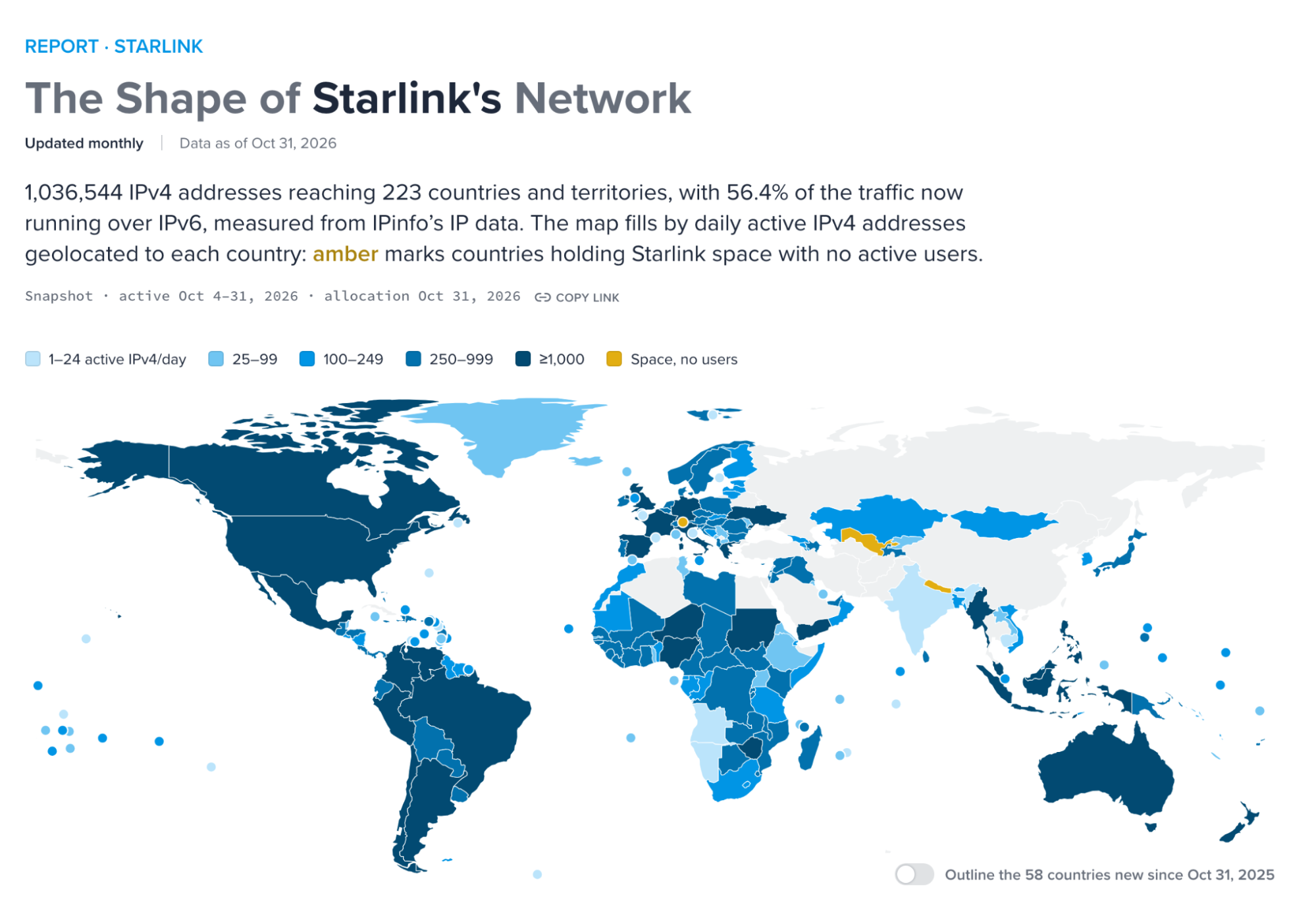
Sign up for freeStarlink lists 17,408 IPv4 addresses for India. On an average day between October 4 and 31, 2026, seven of them were in use. In Ukraine, the space Starlink lists nearly quadrupled in a year, to 29,696 addresses, but only 1,161 of them, about 4%, were in use. India is still waiting for final approvals for Starlink, and in February Ukraine cut off unregistered dishes.
IPv4 addresses are scarce, and Starlink buys most of its blocks second-hand, so each block it lists for a country is a deliberate choice. Read together, those listings show where Starlink is preparing to grow, sometimes before any launch. They also show where it already carries most of the Internet: 60% of the requests IPinfo sees from Niger and 55% from South Sudan in the week of October 19-25, 2026.
You can see some of these findings in our Starlink report published today, The Shape of Starlink's Network. Updated every month, it covers the 223 countries and territories Starlink lists addresses for. It maps how many addresses are in use in each, how fast the network is growing, and how it compares with every other satellite operator. Here is what stood out in it.
Listed Is Not the Same as Used
The report's active share divides the addresses that sent requests on an average day, October 4–31, 2026, by the addresses Starlink lists for each country, for the 57 countries that hold at least 2,048. India is at the bottom with 0.04%, and Ukraine is second from the bottom at about 4%. At the top are Venezuela (45%, 1,159 of 2,560 addresses), Niger (44%, 1,132 of 2,560), and Nigeria (41%, 2,528 of 6,144).
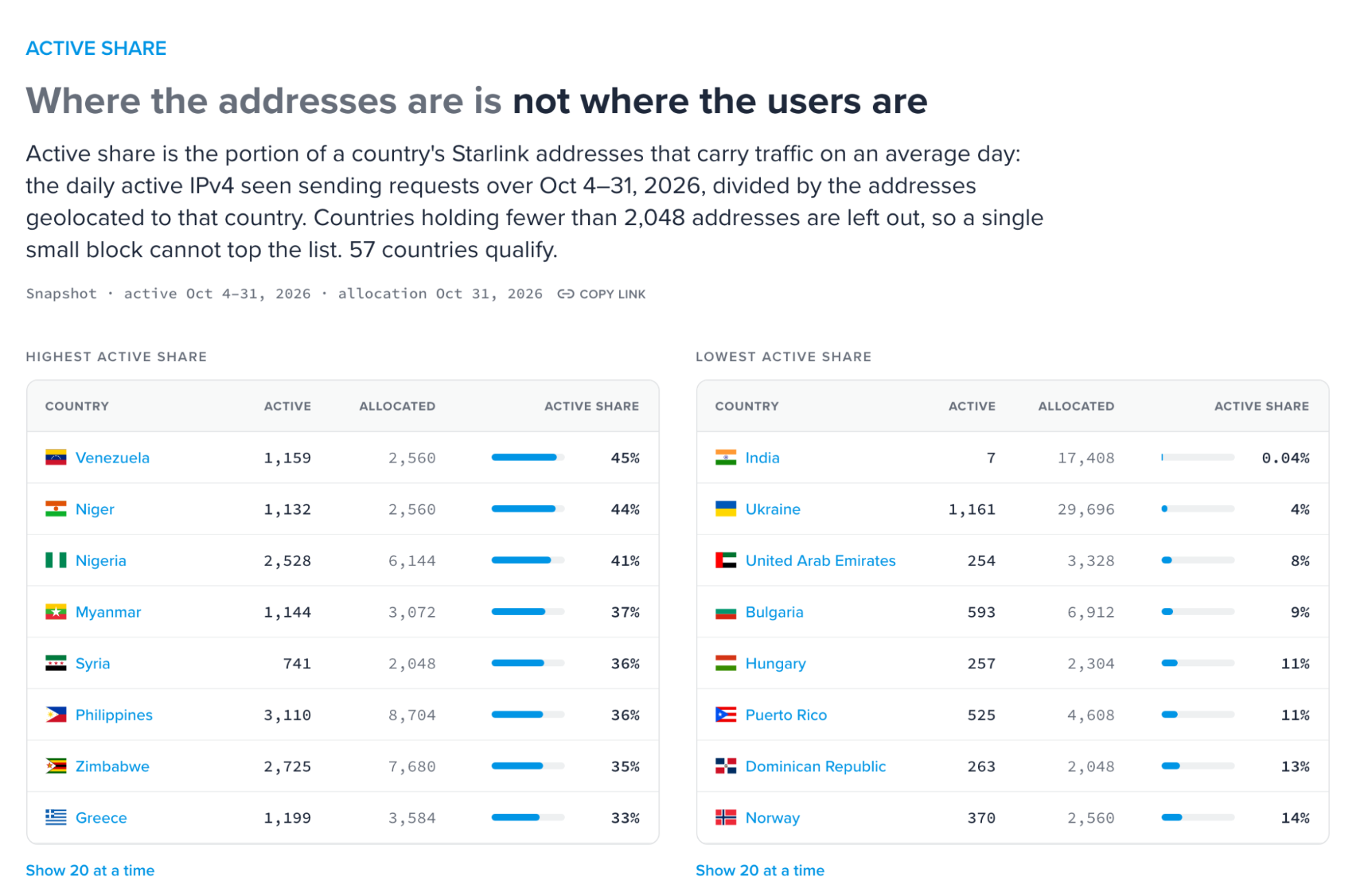
India's addresses are waiting for a launch. Starlink has had its Indian license since mid-2025, but in June security agencies held back the final approvals. Namibia is in a similar place; its regulator rejected Starlink's license in March and upheld the decision in June, and its 512 Starlink addresses are still listed with almost no one on them.
Ukraine's are a different story. Starlink has served Ukraine since 2022. Part of the reason so few are in use is likely the whitelist that Ukraine's government and SpaceX put in place in early February 2026, which cut off unregistered terminals, including those used by Russian forces. APNIC's estimate of Starlink users in Ukraine more than halved between January and June, from about 438,000 to 170,000. Yet all of the new space came after the whitelist. Starlink's own list gave Ukraine 7,936 addresses through February 2026, then added more between March and August. About half of the added space had been listed for other countries in January, mostly Switzerland, the US, Germany and Canada, so Starlink moved it to Ukraine from elsewhere in its pool. The data doesn't show why.
Vietnam shows what happens when a launch is announced. Starlink confirmed its launch there on Wednesday, August 12, 2026. Vietnam's addresses had been listed since at least April 19 and carried almost nothing until August 11 in our data, which runs on UTC. Between October 4 and 31, about 150 IPv4 addresses were active on an average day.
In a Few Countries, Starlink Is Most of the Internet
In a few countries it's the opposite. In Niger and South Sudan, more than half of the Internet requests in IPinfo's CDN request data came over Starlink in the week of October 19–25, 2026: 60% in Niger and 55% in South Sudan. This counts requests, not addresses in use, so it differs from the active share above. Chad was at 44%, Yemen at 41%, and Zimbabwe at 40%, while in the United States the share was 0.6%, fewer than 1 in 100. These are countries where fiber and mobile networks are thin, and a dish on a roof can stand in for a network that would take years to build. The list only includes countries with at least 1 million people online, so tiny islands where Starlink is nearly everything don't crowd the top.
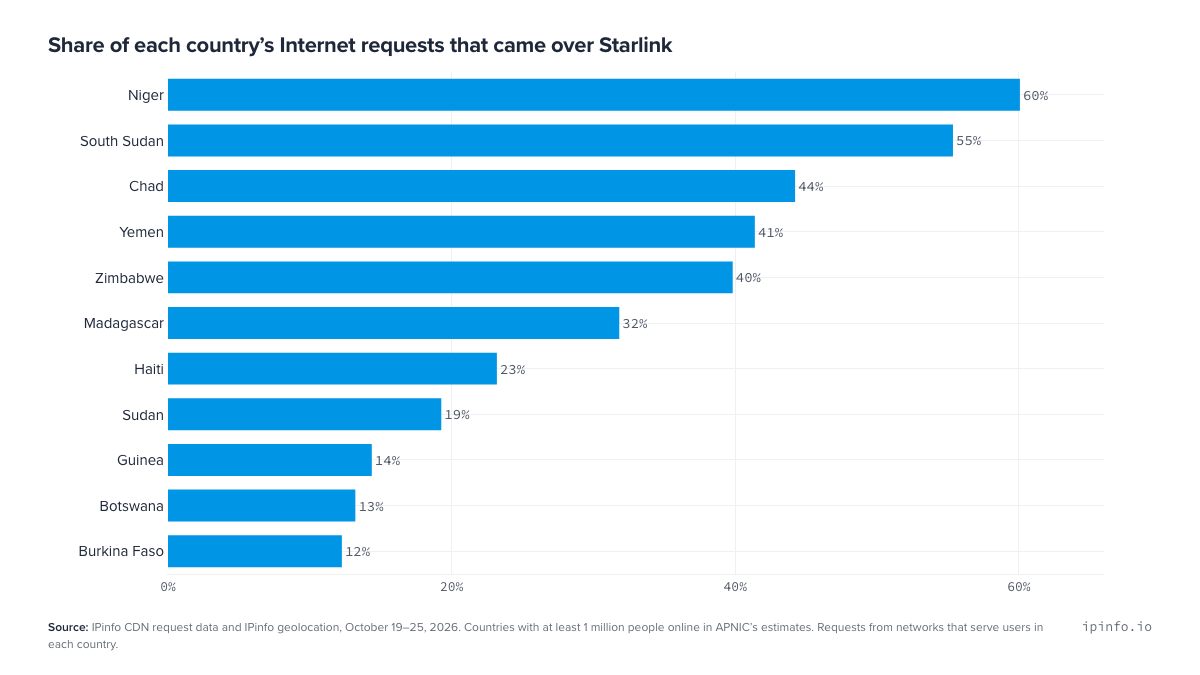
APNIC, the registry for the Asia-Pacific region, estimates how many people use each network from ad samples. That is a completely separate method, and for Niger, Chad, Yemen, and Zimbabwe it lands within a few points of ours. Yemen's number may include ships at sea; Geoff Huston at APNIC has shown that Red Sea shipping gets counted as Yemen.
A share of requests is not a share of people. A home on Starlink, often with several devices behind one dish, can make more requests than a phone on a mobile network, and Starlink's terms allow reselling access as community Wi-Fi. That likely explains the biggest gap in the table, Madagascar: 32% in our data and 19% in APNIC's estimate. In the week of October 5, each Starlink address there made about twice as many requests as one on Telma, the main mobile network.
The share is still rising. Measured one week a month, South Sudan went from 45% in the week of February 9, 2026, to 55% in the week of October 19, Chad from 33% to 44%, and Zimbabwe from 31% to 40%. Niger stayed between 55% and 63%.
58 New Countries and Territories in a Year
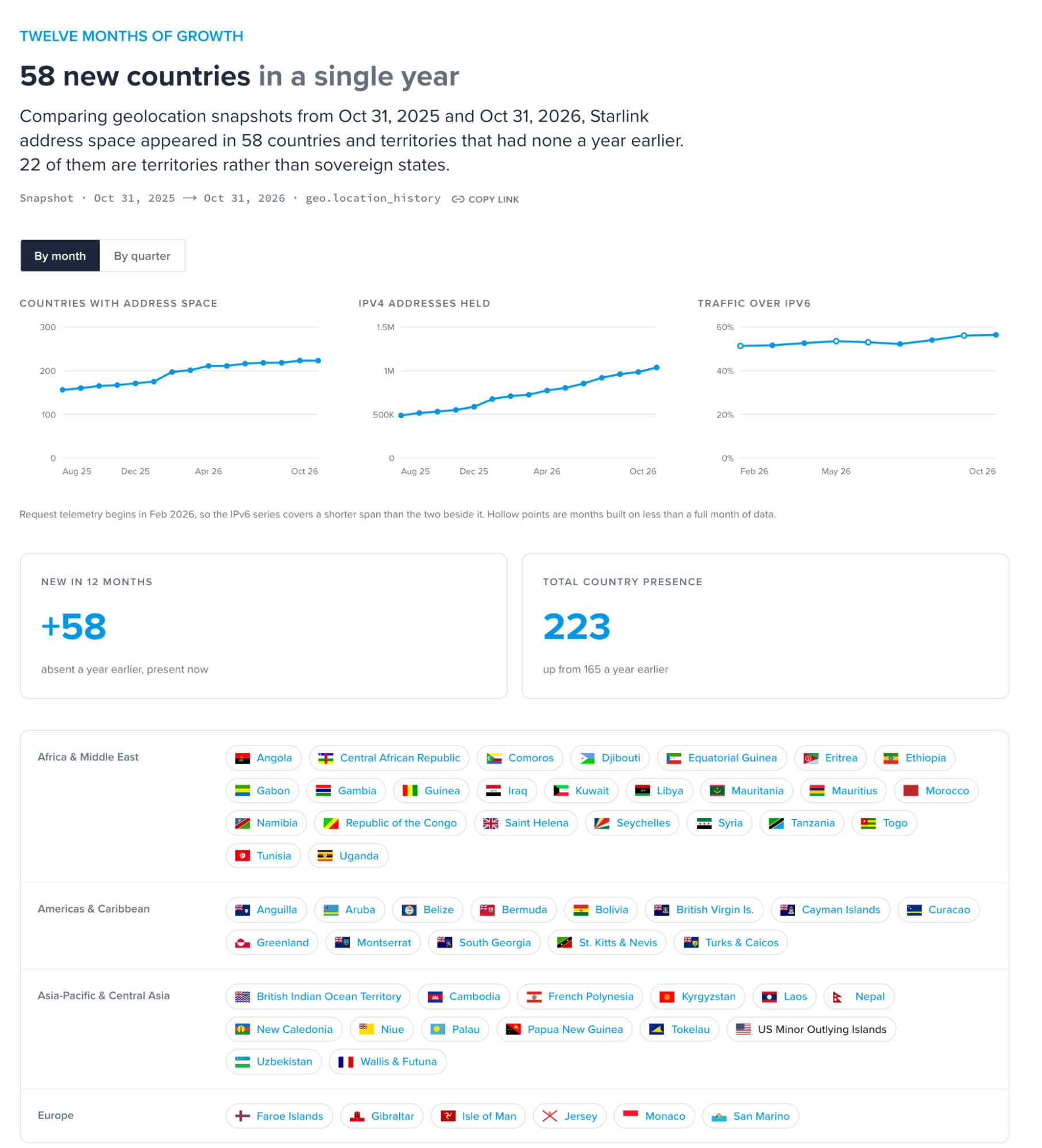
IPinfo places Starlink's addresses using Starlink's own geofeed, a public file that says which block of addresses is used in which city, and counts a country once Starlink lists at least 256 addresses for it. Between October 31, 2025, and October 31, 2026, Starlink space appeared in 58 countries and territories that had none a year earlier, 22 of them territories such as Greenland, Gibraltar, and the Cayman Islands, taking the total from 165 to 223. Starlink's own figure is "more than 160" markets, but the two measure different things. Starlink's counts where service is on sale, while a listing can come before any launch.
The list also works like a launch calendar. Cambodia's telecom regulator said SpaceX has no license to operate in the country on August 22, 2025, and that importing, selling, or using Starlink kits is illegal. In September 2026, Starlink began listing a block of addresses for Phnom Penh. Between September 16 and 18 those addresses started carrying traffic, about 16 of them a day, counting IPv4 and IPv6.
Cambodia was one of five countries that appeared in the feed for the first time that month:
- September 3: Morocco (Rabat)
- September 9: Cambodia (Phnom Penh) and Laos (Vientiane)
- September 10: Tunisia (Tunis) and the Republic of the Congo (Brazzaville)
Starlink announced each block to the rest of the Internet within days of listing it. Until September 15, none had any users. Our traffic data has no records for September 16 and 17. On September 18, the first day with data again, all five were active. Four have stayed that way through October. In Cambodia, use fell to one or two addresses a day from October 21, although Starlink still lists the block.
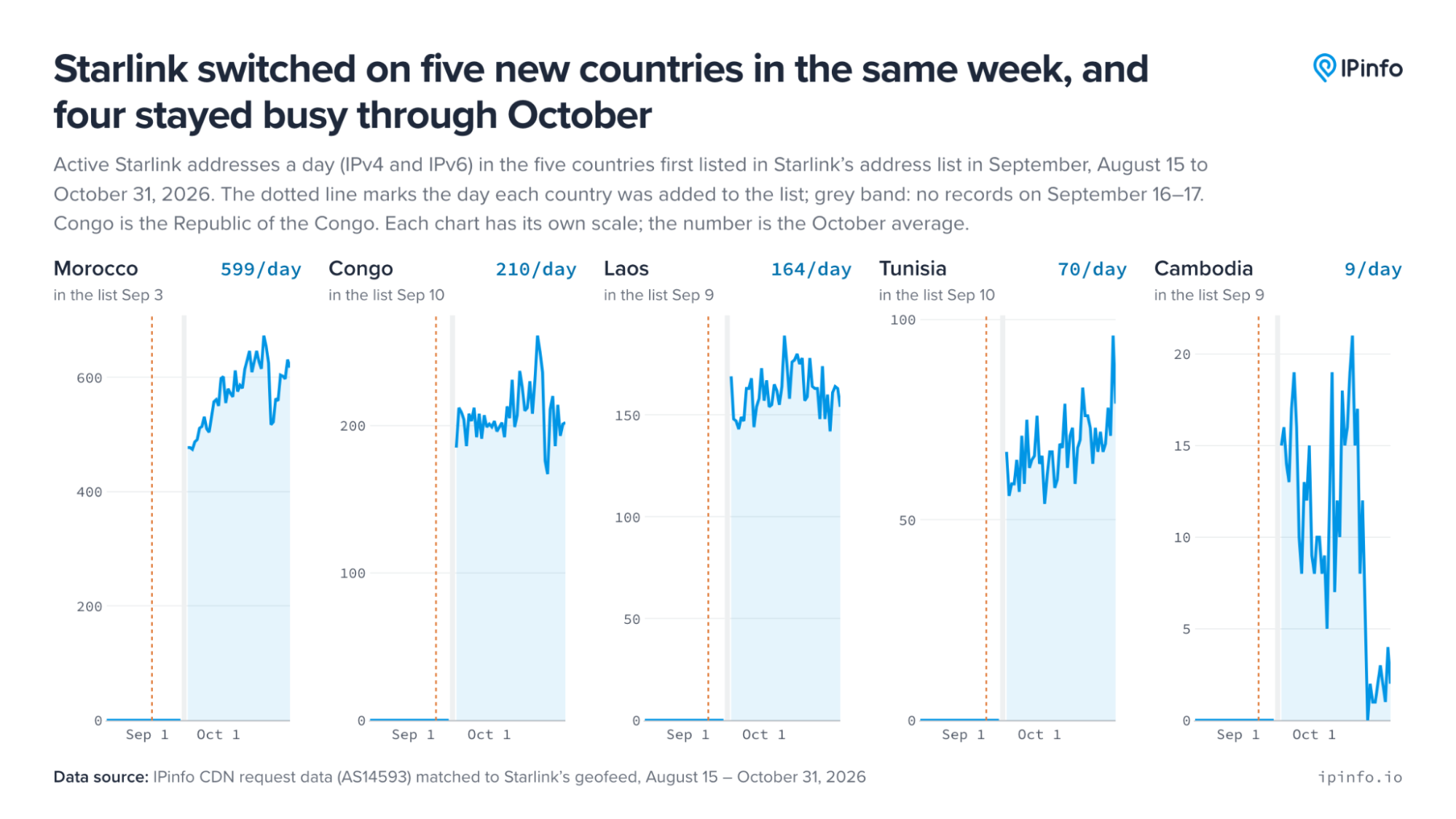
Daily averages for September 18–23, with IPv4 for October 4–31 next to them:
A new service usually grows slowly, as people buy dishes and set them up. These five didn't: they were busy from the first day with data. None of this means Starlink is selling service against the rules. A dish bought where Starlink is licensed can travel on a roaming plan, and ships and planes carry dishes across borders. Tunisia had no license for Starlink as of February (French article in the link), and in Morocco Starlink registered a local subsidiary in April, with approvals still pending at the time.
Nearly Twice the Addresses in a Year
SpaceX's four Starlink networks held 1,036,544 IPv4 addresses on October 31, 2026, up 95% from 531,200 a year earlier, after passing 1 million on October 8. The space Starlink lists for the United States grew 97% in the year to October 31, to 253,888 addresses. Ukraine's grew 274%, to 29,696, and India's 240%, to 17,408.
Most of them were bought second-hand. (At least 98% of the IPv4 addresses Starlink announced on October 2, 2026 sit in blocks SpaceX bought from other companies, according to the regional registries' transfer records.) Starlink stretches each address a long way. At the end of September, SpaceX reported 13.6 million customers in its third-quarter results, about 14 customers for every IPv4 address it held then. More and more of its traffic skips IPv4 entirely: in October 2026, 56.4% of the requests on its main network came over IPv6, up from 51.3% in February.
No Other Satellite Network Comes Close
In October 2026, Starlink carried 95.8% of the requests from satellite operators' networks in IPinfo's CDN request data. Hughes was next at 1.9%, and Viasat at 1.3%. Ookla sees nearly the same from the other side; Starlink customers make up 97% of its satellite speed tests.
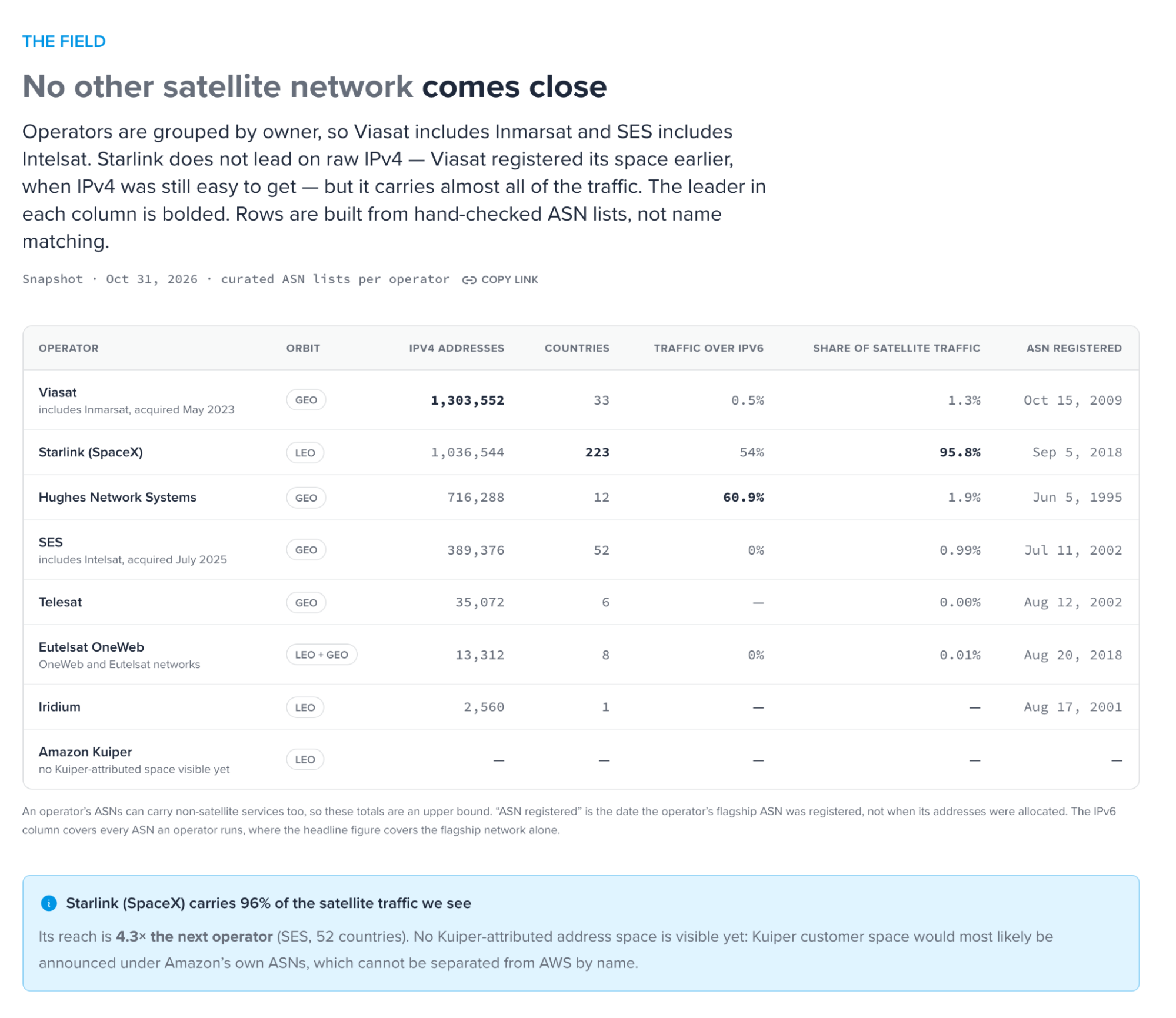
Starlink doesn't hold the most addresses, though. Viasat, which includes Inmarsat, held 1,303,552 IPv4 addresses on October 31, against Starlink's 1,036,544. Viasat's network was registered in 2009, while IPv4 was still easy to get. SpaceX registered its main network in 2018, three years after North America's registry gave out its last free IPv4 addresses. The closest new rival, Amazon Leo, had 396 satellites in orbit after its last launch in July, and on October 29 Amazon said initial service was still on track to start this year.
How We Measured It, and What It Can't Tell You
Starlink runs almost all of its users through one network, so the network itself says nothing about the country. IPinfo starts from Starlink's own list, which places about 85% of Starlink's IPv4 addresses, and agrees with it on the country for 99.9% of the addresses it covers. IPinfo's CDN request data is the requests seen by a large content delivery network IPinfo works with, with each client address placed using IPinfo's geolocation. An address counts as active on a day when it sent requests in that data. Active addresses are not subscribers. Starlink puts many users behind each one, and IPv6 traffic falls outside the IPv4 counts. We can't tell a licensed customer from a roaming dish, a ship, or someone using Starlink where it is banned.
Explore the Report
The Shape of Starlink's Network is updated every month. Pick any country to see how many Starlink addresses it holds and how many are in use, compare it with up to two others, or see which countries got Starlink space for the first time in the past year. The data behind it, from IPinfo's ASN and geolocation datasets, is available by API or database download.
This is one of IPinfo's data stories, where we use our own measurements to look at what happens on the Internet. If you spot something we got wrong, have data that adds to this, or have a story you'd like us to look into, write to us at emot@ipinfo.io.
Share this article


About the author

João Tomé is an Internet Data Research Editor at IPinfo, finding trends and stories about how the Internet works and changes. He has a background in journalism, data storytelling, and podcasting, including five years at Cloudflare. joaotome.com